 VERILUME
Creative Production
Before You Brief a Video Editor, Decide What the Viewer Should Do Next
Better short-form video often starts before the footage reaches an editor. A clear brief keeps revisions short and the edit pointed at one purpose.
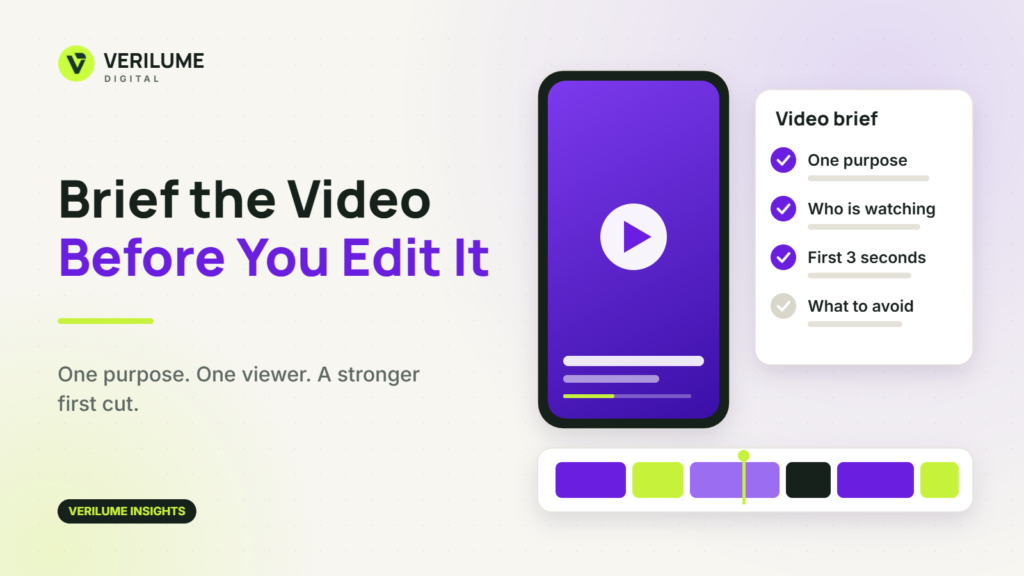
Many video projects begin with a folder of clips and a loose instruction: make it engaging. An editor can cut, caption and add music, but “engaging” is not a destination. Without a clearer brief, revision rounds tend to turn into a search for what the video was meant to do.
A brief does not need to be long. It needs to settle a few decisions before the first cut.
Name one purpose for the video
Is it meant to introduce a service, show a finished piece of work, answer a common question or invite someone to get in touch? A video that tries to do all four usually does none of them well.
Choosing one purpose gives every shot, caption and second of runtime something to be measured against. It also makes feedback easier, because the question becomes whether a moment helps that purpose rather than whether someone likes it.
Describe the viewer, not just the platform
Saying a video is for Instagram or YouTube tells an editor about format. It says very little about who will be watching.
A homeowner scrolling between friends’ posts, a procurement manager skimming at a desk and an existing client checking in all need different openings. Describe who the viewer is, what they probably already know and what might make them stop scrolling.
Decide what the opening has to do
Short video is judged quickly. The first moments should show or say why this is worth watching, in plain language the viewer can follow without sound if necessary.
A logo animation before the point is a common way to lose attention. So is an opening that takes several seconds to reach the subject. If the strongest moment is in the middle of the footage, consider whether it belongs at the start.
Supply the material and the limits together
Give the editor everything in one place: the raw footage, logos, fonts, approved wording and any reference videos that show the style you like. Then add the limits, which are just as important.
Say what must not appear. That might include claims you cannot support, people who have not agreed to be filmed, or client details that are confidential. If music or sound effects are used, confirm that they are licensed for commercial use before the video is published, not afterwards.
For the kinds of projects this applies to, see our work in short-form video and social media creative.
Agree how feedback will work
Feedback is faster when it arrives as one consolidated set of notes rather than a trickle of messages from several people. Say what should change and why. “The second sentence is too technical for this audience” gives an editor something to act on. “Make it pop” does not.
It also helps to agree in advance how many revision rounds the project includes and who has the final say, so the edit does not drift.
Keep a note of what you learn
After the video is published, look at where viewers stopped watching and what questions they asked in the comments or messages. Those observations belong in the next brief.
Over a few projects, the brief becomes a short, reusable document that reflects what actually works for your audience. That is worth more than any single edit.
Plan the formats at the briefing stage
One shoot can often support more than one video: a vertical cut for short-form platforms, a square or horizontal version for a website, and a shorter teaser. Decide this in the brief so the footage is captured with those crops in mind, with important details kept away from the edges of the frame.
It is much easier to plan formats before filming than to rescue a shot afterwards. It also keeps the editor from guessing which version matters most.
Treat sound and captions as part of the story
Many people watch short video without sound, particularly on a phone in a public place. Captions should be accurate, easy to read and timed to the speech, and the key message should still make sense if the sound stays off.
Ask for a read-through of the captions before delivery, since misspelled names and technical terms are easy to miss and difficult to excuse once the video is live.
If you are planning a video and want to talk through the brief, tell Verilume Digital what the video should achieve when you request a quote.