 VERILUME
B2B Lead Generation
How to Build a High-Quality B2B Prospect List Without Buying a Database
A larger prospect list does not automatically mean more opportunities. Good B2B prospecting starts with knowing who actually fits, researching each company, and finding the best available way to reach the right person.
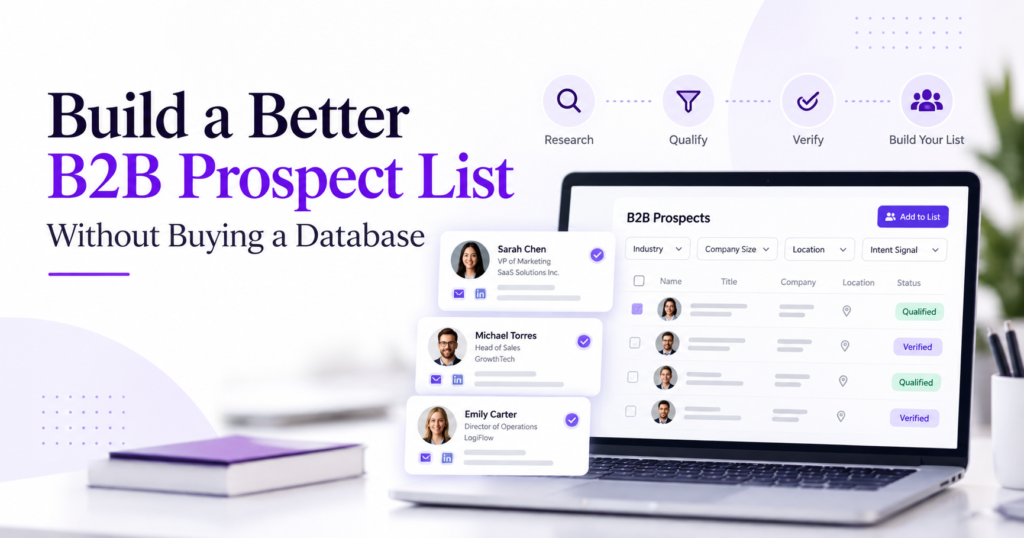
It is easy to find thousands of company names online.
Building a list of companies that are actually worth contacting is a different job.
That difference matters because a sales team does not benefit from having 10,000 rows in a spreadsheet if half of them are irrelevant, outdated, duplicated, or connected to the wrong people.
A useful prospect list should make the next step easier.
Someone looking at it should be able to understand who the company is, why it fits the target market, who may be worth contacting, and how to reach them.
That usually requires more research than simply exporting data from a database. For teams that need research built around defined targeting criteria, explore our B2B lead generation services.
Start with the buyer, not the spreadsheet
Before collecting anything, define what a qualified prospect looks like.
That can include things such as:
- industry
- location
- company size
- services offered
- customer type
- job titles
- business model
- specific problems the company may have
For example, “software companies in the United States” is still extremely broad.
A more useful target might be:
B2B SaaS companies in the United States with 10–100 employees that are actively selling to small and mid-sized businesses.
Now the researcher has something meaningful to work with.
The clearer the target is, the less time gets wasted later.
A database should be a starting point, not the final answer
Databases and automated tools can be useful for discovery.
The problem starts when an exported list is treated as finished research.
Companies change. People change jobs. Job titles change. Websites disappear. Businesses move into different markets. Email addresses stop working.
And sometimes a company technically matches a filter but clearly does not make sense once someone actually visits its website.
That is why we prefer to treat automated data as one possible research input rather than the final source of truth.
The company itself still needs to be checked.
Visit the company website
This sounds obvious, but it is one of the most valuable parts of prospect research.
A company website can answer questions that a database often cannot.
What does the business actually sell?
Who does it serve?
Is it still active?
Does the company operate in the market you are targeting?
Does it appear to have the problem your service solves?
Who is on the leadership or sales team?
Is there a contact page, team page, location page, press release, or other useful information?
A few minutes of human review can remove a surprising number of poor prospects.
And that improves the list before anyone starts outreach.
Find the right person, not just any person
Finding a company is only half the job.
The next question is: who should you actually contact?
The answer depends on what you are selling.
If the offer is related to marketing, the right person may be a marketing director, founder, growth lead, or head of demand generation.
If the service is related to operations, the decision-maker may be completely different.
For smaller businesses, the founder or owner may still be the most relevant person.
For larger organizations, contacting the CEO for every offer often makes very little sense.
Good prospect research tries to match the person to the reason for outreach.
That creates a much stronger list than simply collecting the highest-ranking executive available.
Look for the best available business contact
An email address is useful only when it gives you a realistic way to reach the prospect.
Whenever possible, we prefer a direct professional email connected to the relevant person.
If that is not publicly available or reasonably verifiable, a relevant general business address can still be useful.
Examples might include hello@company.com, sales@company.com, info@company.com, or a department-specific email.
The goal should not be to fill every email cell at any cost.
A wrong email does not improve the list.
Sometimes leaving a field blank is more useful than adding information that cannot be trusted.
Add context, not just contact details
One of the biggest improvements you can make to a prospect list is adding information that helps someone understand the company quickly.
Depending on the project, that might include company website, location, industry, contact name, job title, business email, phone number, company size, relevant service, target market, or research notes.
The exact columns are less important than the purpose behind them.
A salesperson should not need to start the entire research process again after receiving the list.
The research should help them prepare for outreach.
Quality control matters more than people think
Prospect lists become messy very quickly.
Before delivery, it is worth checking for duplicates, wrong locations, outdated contacts, irrelevant businesses, broken URLs, inconsistent company names, and formatting problems.
Search engines and databases often return companies that match keywords but not the actual targeting criteria.
Cleaning the list is part of the research, not an optional extra.
More leads are not always better
Suppose one researcher delivers 2,000 prospects and another delivers 400.
The 2,000-row file may look more impressive at first.
But if the 400 prospects are much closer to the ideal customer profile, contain better contacts, and require less manual checking, that smaller list may have significantly more practical value.
Lead generation should not become a competition to produce the biggest spreadsheet.
The goal is to create a useful sales asset.
Build lists around an outreach strategy
Prospect research becomes much more valuable when it is connected to what happens afterward.
Before building the list, ask:
Who will contact these companies?
By email, LinkedIn, phone, or another channel?
What will the message say?
What makes the offer relevant to this particular group?
What information would make personalization easier?
Those questions can change what data should be collected.
If personalized outreach is planned, for example, collecting one useful research note about each company may be more valuable than collecting five additional generic fields.
The best prospect lists involve judgment
Tools can make research faster.
Automation can help discover companies.
Search platforms can help locate people.
Email tools can help verify contact information.
But there is still an important human layer: deciding whether a prospect actually belongs on the list.
That judgment is what turns raw information into useful sales research.
A good B2B prospect list is not simply a collection of contacts.
It is a filtered view of the market your business wants to reach.
And when that foundation is accurate, everything that comes after it—outreach, personalization, follow-up, and sales conversations—has a better starting point.
Need a prospect list built around your actual target market?
Verilume Digital provides research-led B2B lead generation and prospect list building based on your industry, geography, buyer profile, and outreach goals.
Let’s discuss your project →