 VERILUME
CASE STUDY · Web Development, WordPress CMS, Technical SEO, Conversion Tracking, Analytics Setup
Building Verilume Digital: From Custom Code to a Production-Ready Growth Website
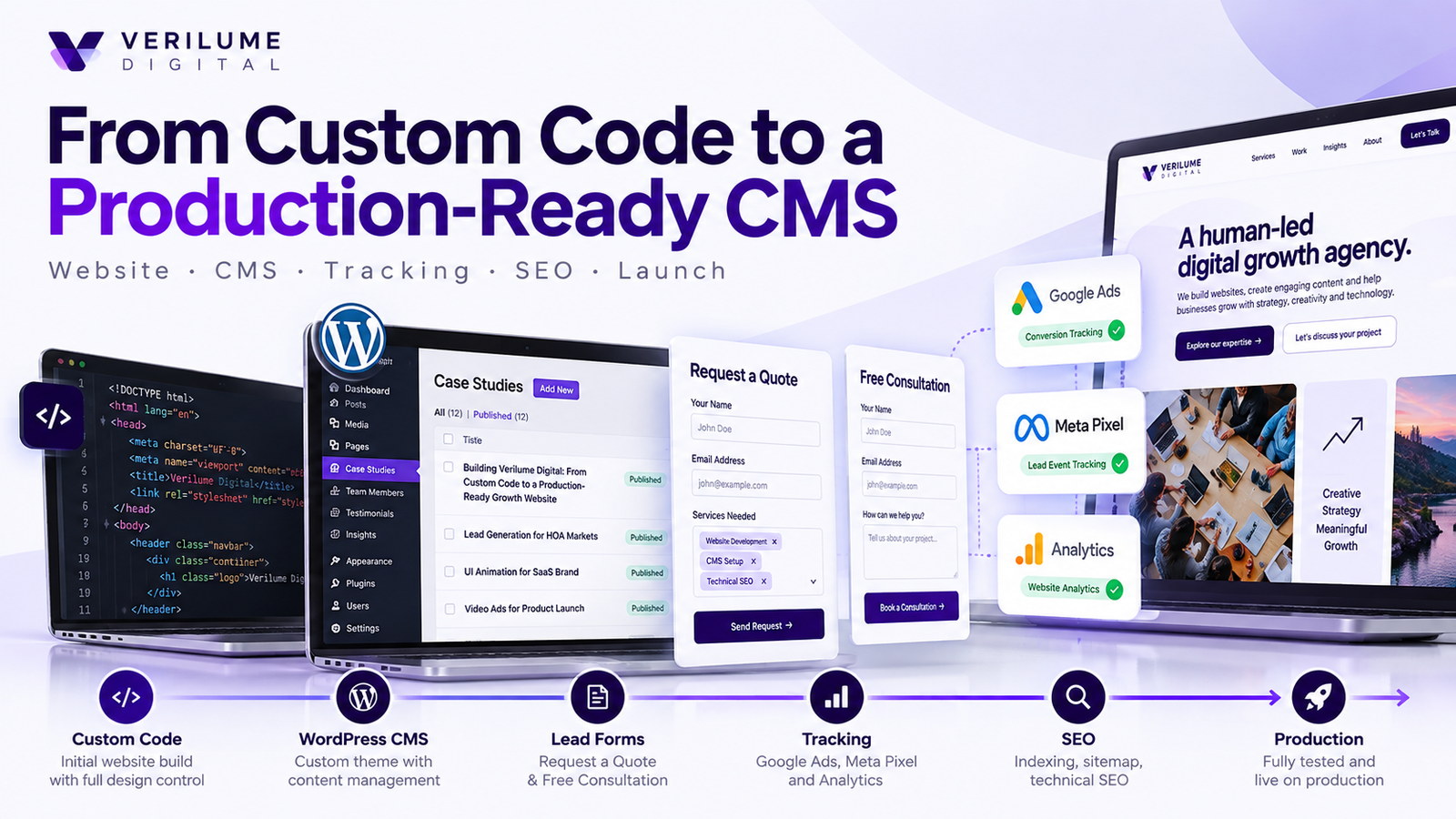
Verilume Digital began as a custom-coded agency website and evolved into a production-ready WordPress platform with a custom CMS, lead workflows, advertising tracking, technical SEO and a controlled staging-to-production process.
THE CHALLENGE
What the project needed to solve
Verilume Digital began as a custom-coded website built for clarity, speed and direct control over the visual experience. As the business developed, the site needed to become easier to manage without losing that custom feel.
The challenge was to introduce a practical CMS, lead-generation workflows, analytics, advertising tracking and search visibility while preserving the existing design. Team information, case studies, insights and testimonials also needed to become editable without requiring code changes.
At the same time, development activity had to remain separate from production analytics, enquiry forms had to work reliably, and the final migration needed to happen without losing the live site or its existing structure.
THE APPROACH
How we structured the work
We kept the original custom website as the visual foundation and built the management layer around it rather than redesigning the project around a generic WordPress template.
A custom WordPress theme was created to preserve the existing interface while introducing dedicated CMS areas for Team Members, Case Studies, Insights and Testimonials. Global business information was moved into central settings so recurring details could be updated from one place.
A staging environment was used throughout the conversion. Forms, email delivery, Google Ads tracking, Meta Pixel, consent behaviour and search-engine settings were tested there before the finished WordPress build was migrated to the production domain.
After launch, the live environment was tested again independently instead of assuming that everything working on staging would behave identically in production.
DELIVERABLES
What we delivered
Use one item per line if the CMS displays line breaks nicely:
Custom WordPress theme based on the original Verilume design
Responsive desktop and mobile website
CMS for Team Members, Case Studies, Insights and Testimonials
Central business and social profile settings
Request a Quote workflow
Free Consultation workflow
Multiple-service enquiry selection
Business email delivery
Google Ads base and conversion tracking
Meta Pixel and Lead-event tracking
Consent-aware advertising scripts
Staging protection for production analytics
XML sitemap and robots.txt configuration
Canonical URL structure
Google Search Console verification
Production migration and rollback backups
Post-launch indexing and performance QA
OUTCOME
What the project established
The finished website moved from a static custom-coded build into a manageable production platform without losing the original Verilume visual identity.
The team can now update people, case studies, insights, testimonials and business information through WordPress rather than editing theme files for routine content changes.
Both enquiry paths were verified from form submission through email delivery. Google Ads conversion tracking and the Meta Lead event were also confirmed on the live domain, while staging activity remains isolated from production advertising data.
Search-engine indexing was tested after launch, including the identification and removal of a migrated noindex directive.
Final PageSpeed testing recorded:
98 — Desktop Performance
100 — SEO
100 — Best Practices
96 — Accessibility
~89–90 — Mobile Performance
The result is a website that can now support ongoing publishing, campaign measurement, lead capture and future business growth without requiring a rebuild whenever the content changes.
PROJECT NOTES
Project Overview
Verilume Digital began with a custom-coded website that gave us full control over the visual experience.
That worked well for the first stage of the business, but the limitations became clearer as the site started carrying more responsibility.
Team information needed to change. New case studies and insights needed to be published. Testimonials would grow over time. Business details had to stay current. And every small update should not require someone to open the codebase.
The project therefore became less about rebuilding the website and more about making the existing website easier to operate.
The goal was to keep the custom front-end experience while giving the business a practical system behind it. Explore our website development services for business websites, WordPress builds and ongoing improvements.
Building the Lead Workflow
The website needed more than a contact form.
We created two enquiry paths: Request a Quote for visitors with a defined project and Free Consultation for people who wanted to discuss their needs first.
Both forms were designed to collect enough context to make the first follow-up more useful, including service interest, project details and preferred contact information.
During testing, one of the forms failed even though the interface itself looked correct.
Instead of treating it as a generic email problem, we followed the request through the browser’s Network panel. That exposed a JavaScript conflict affecting the WordPress endpoint used to submit the form.
Once corrected, we tested the complete flow again:
Form submission → WordPress processing → business inbox → conversion event
The final test confirmed that both enquiry paths were working end to end.
Keeping Staging and Production Separate
The staging website was useful for testing the CMS, forms and technical changes, but it also created an analytics problem.
Internal testing should not look like real customer activity.
Google Ads and Meta tracking therefore needed different behaviour depending on the environment.
On staging, advertising tracking and conversion events remain disabled.
On the live domain, the relevant scripts can load after the visitor provides the appropriate consent.
We verified the live setup through browser network requests rather than relying only on the presence of tracking code.
This confirmed that Google Ads tracking, the enquiry conversion event, Meta Pixel and the Meta Lead event were reaching their respective platforms from the production site.
The Indexing Issue We Caught After Launch
One of the most valuable checks happened after the migration was already complete.
The staging site had correctly been configured to discourage search engines while development was in progress.
When the WordPress database was copied to the live domain, that setting initially followed it.
To a visitor, the website looked completely normal.
But Google Search Console’s live test reported that the page could not be indexed because of a noindex directive.
We confirmed the directive directly in the live page source.
The WordPress search visibility setting was reset, the relevant caches were cleared and the live source was checked again.
The noindex directive disappeared, and a new Google live test reported that the homepage was available for indexing.
It was a small technical issue with a large potential consequence, and one that would have been easy to miss without post-launch QA.
What This Project Reinforced
This project reinforced something we now treat as a basic principle:
a business website is not only the part a visitor sees.
The interface matters, but so do the systems behind it.
Content management determines how easily the website can evolve.
Forms determine how enquiries enter the business.
Email delivery determines whether those enquiries are actually received.
Tracking determines whether marketing activity can be measured.
Consent affects how that tracking should behave.
Search configuration determines whether the website can be discovered.
Backups and staging affect how safely future changes can be made.
The strongest outcome from this project was not simply moving a custom website into WordPress.
It was creating a foundation that Verilume Digital can continue to use, measure and improve as the business grows.
START A CONVERSATION
Have a project that needs a clear, practical approach?
Tell us what you need to research, build, produce or improve, and where you need support.
Discuss your website project