 VERILUME
CASE STUDY
Mapping 600+ Luxury Brands Across the Global Retail Ecosystem
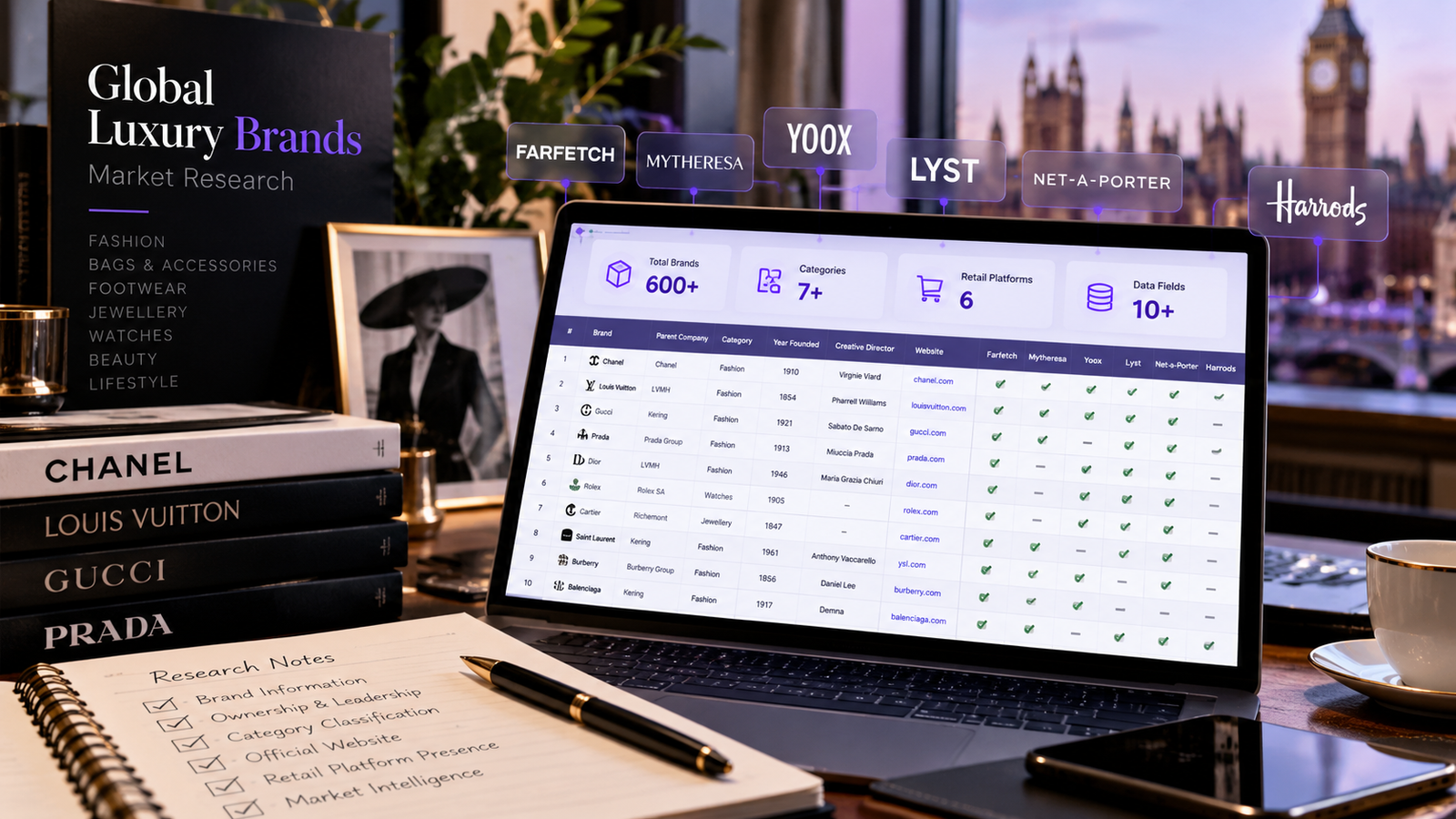
A structured market-research project mapping 600+ luxury and fashion brands across ownership, leadership, categories, company history, and major global retail platforms.
PROJECT NOTES
Turning fragmented brand information into a structured market-intelligence resource.
Luxury and fashion markets contain a huge amount of publicly available information—but that information is spread across individual brand websites, retailer platforms, reference sources, and company profiles.
This project required turning that fragmented information into a structured database that could actually be filtered, compared, and used for research.
The final dataset contained 600+ researched brand records, covering luxury, fashion, footwear, jewellery, sportswear, and related categories.
The Challenge
The objective was not simply to produce a long list of brand names.
Each company needed additional context so the dataset could support deeper market analysis.
The research included fields such as:
- Brand name
- Parent company
- Product/category
- Year founded
- Founder
- Creative director
- Official website
- Reference sources
- Presence across major online luxury retailers
- Additional brand information
This meant information often had to be located across several different sources before one brand record could be considered useful.
Our Research Approach
We approached the project as a structured market-research and data-enrichment exercise, rather than basic list building.
Each brand was researched individually and organized into a consistent data structure.
For example, distribution and marketplace presence could be examined across major luxury-commerce platforms such as Farfetch, Mytheresa, Yoox, Lyst, Net-a-Porter, and Harrods.
This allowed the dataset to show not only who the brands were, but also provide context around their history, leadership, ownership, category, and retail footprint.
This type of research follows the same human-led methodology we use across our B2B research and lead-generation work: define the information requirement first, research from relevant sources, structure the findings, and then perform quality control before delivery.
From Scattered Information to Structured Data
One of the main challenges in large research projects is inconsistency.
Different brands publish different levels of information. Retail platforms categorize products differently. Company histories and leadership details can also appear across multiple sources.
Our job was to turn those inconsistencies into a dataset with a repeatable structure.
Instead of leaving the client with hundreds of browser tabs and disconnected research notes, the information became one centralized research asset.
The dataset supported analysis across:
600+ brand records
Multiple fashion and luxury categories
Founders and creative leadership
Parent-company relationships
Brand history and founding information
Official company websites
Multi-platform retail presence
That structure made the research significantly easier to filter, segment, review, and extend.
The Result
The finished project provided a centralized market-intelligence database covering hundreds of brands across the global luxury and fashion ecosystem.
Rather than repeatedly researching the same companies across separate websites, the client could work from one structured source containing the important information required for further analysis.
The database could then support use cases such as:
- market segmentation
- competitor research
- brand discovery
- retail-channel analysis
- partnership research
- category analysis
- company profiling
- future prospecting and enrichment
The value of the project came not simply from the number of records collected, but from making the information usable.
What This Project Demonstrates
Large-scale web research becomes valuable when information is collected with a clear structure and purpose.
A spreadsheet containing hundreds of rows can still create more work if the information is incomplete, inconsistent, or difficult to interpret.
Our approach combines manual research, structured data collection, enrichment, and quality control so that the final dataset can support an actual business decision or workflow.
You can see another example of this approach in our County Outreach Research case study, where fragmented local-market information was transformed into qualified outreach data.
If your business needs a custom research database, prospect list, market map, or manually enriched dataset, request a quote and tell us what you need to understand.
START A CONVERSATION
Have a project that needs a clear, practical approach?
Tell us what you need to research, build, produce or improve, and where you need support.
Start a conversation