 VERILUME
Digital Marketing & Growth
Google Ads or Local SEO? Start With the Question the Customer Is Asking
Paid search and local search can both bring enquiries, but they work on different timelines. Here is how a service business can decide where to begin.
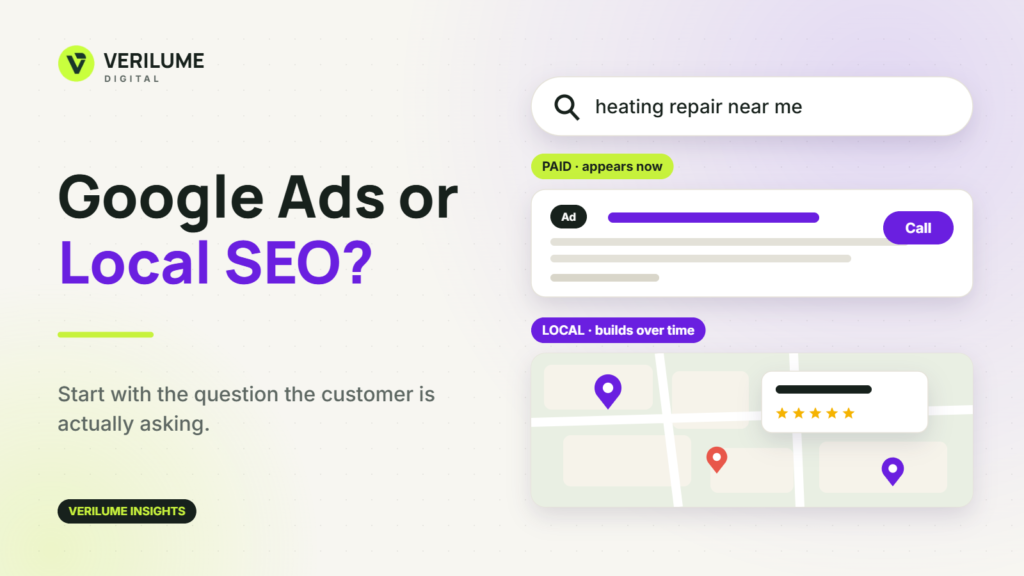
When a local service business wants more enquiries, the conversation often narrows quickly to a single choice: run Google Ads or invest in local SEO. Both can put a business in front of people who are searching. They do not work in the same way, and they do not suit the same moment.
A more useful starting point is the situation behind the search. Someone whose heating has stopped working and someone comparing three contractors for a spring renovation are both typing into Google. They are not looking for the same experience, and they will not respond to the same page.
Paid search buys placement now
Google Ads can place a business in front of a relevant search soon after a campaign is approved and live. That speed is useful when a service is ready to sell, there is capacity to take on work, and the business wants to learn which searches lead to real enquiries.
The trade-off is that visibility lasts only as long as the budget does. Costs vary by service, location and competition, so it is wise to start with a modest test, watch enquiries rather than clicks, and decide what a qualified enquiry is worth before spending more.
Ads also need somewhere good to land. A click that arrives on a vague home page wastes much of what the budget paid for, which is why landing pages belong in the same conversation as the campaign itself.
Local SEO builds something people can find over time
Local SEO covers the map results and local listings people see when they look for a service nearby, along with the website pages that explain what the business does and where. The work includes accurate business information, clear service and location pages, and a steady approach to genuine customer reviews.
This kind of work tends to build gradually rather than switch on overnight. Nobody can honestly promise a ranking position, and it is worth being cautious about anyone who does. What a business controls is the quality, accuracy and consistency of what it publishes and maintains.
Match the channel to the stage of the business
A business with a clear offer, spare capacity and a pressing need for enquiries may reasonably begin with a small paid test. A business that already has steady work and wants fewer quiet weeks may prefer to strengthen its local presence first.
Many businesses end up using both, one informing the other. The search phrases that lead to enquiries in an ad campaign can show which service pages are worth writing or improving. The pages that perform well can then support the next campaign.
Check the basics before spending on either
Whichever route comes first, a few things should be in place. The website should explain the services plainly. Contact details should work well on a phone. Listing information should match across the web. And there should be a way to tell which enquiries came from where.
Without that last piece, neither channel can be judged fairly. A campaign may look quiet when the phone is actually ringing, or look busy when the calls are not a fit.
Decide what you will review, and when
Set a review rhythm before the work starts. Look at the enquiries received, which of them were a good fit, what they cost to win and what people asked about. Those observations are more useful than a single headline number, and they make the next decision easier to explain.
Think about the seasons
Demand for many home and property services moves with the calendar. Heating, cooling, roofing, landscaping and renovation work all have busier and quieter periods, and the questions people ask change with them.
A paid test is often most useful just before or during a busy period, when search volume is already there and the business can handle the work. Local pages, listing updates and review requests are better started earlier, so they are already in place when demand rises.
Keep the message consistent in both places
Someone may see an ad, then check the map listing, then open the website. If the service area, opening hours or main offer differ between them, the business looks careless at exactly the moment a visitor is deciding.
Before launching either channel, check that the same services, hours and contact details appear in the ad, the listing and the site, and that any special offer mentioned in an ad is still available on the page it points to.
If you are weighing paid search against local visibility, tell Verilume Digital which services you want more work for and the area you cover when you request a quote.